
MASTER CRASH GAME · RUMMY
Indian Rummy Rules: Learn the 13-Card Game
 Author: Ishani Bendre · Editorial lead: Revat Desai · Updated
Understand 13-card Indian Rummy: drawing, discarding, pure sequences, sets and declarations. Compare formats and check the rules that vary by table.
Android download · 58.9 MB · Android 5.0+ · File information

MASTER CRASH GAME
Rummy
Rummy concepts at a glance
Concept illustrations — not screenshots of the supplied APK.
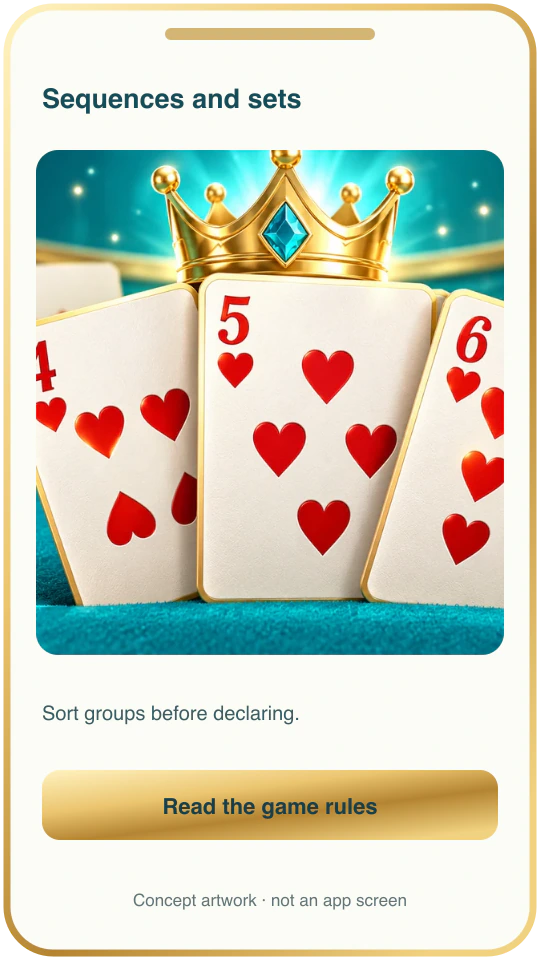
This overview covers Indian Rummy, often described as classic Rummy or 13-card Rummy. “13 Patti” in this context refers to the thirteen-card game, rather than the three cards of Teen Patti. pure sequence in Rummy · valid Rummy declaration · Rummy drop rules.
How to play Rummy
- A common Indian Rummy format uses 13 cards. Check the selected variant, number of decks and joker selection before arranging the hand. The rules define which combinations can count toward a declaration.
- On a typical turn, draw a card from the permitted pile and discard one. Keep the order of those actions clear. The timer and disconnection response are product settings, not universal values for every Rummy table.
- In the usual 13-card declaration pattern, the hand needs at least two sequences and at least one pure sequence. A pure sequence uses consecutive cards of one suit without substituting a joker for a missing rank.
- Build the remaining cards into valid sequences or sets. A set groups equal ranks in different suits. Repeated copies of the identical suited card from two decks do not automatically become a valid set.
- Review all 13 cards before making the final declaration. The precise finish action, scoring, drop penalty and handling of an invalid declaration must be read in the table rules.
Group requirements
Swipe sideways to read the full table →
| Group | Example | What to check |
|---|---|---|
| Pure sequence | 4♣ 5♣ 6♣ | Consecutive suited ranks with no substituted card. |
| Impure sequence | 9♥ Joker J♥ | A joker substitutes for the missing 10♥ if permitted. |
| Set | 8♣ 8♦ 8♥ | Matching rank with different suits. |
| Deadwood | Ungrouped cards | Read the selected format’s penalty model. |

Rummy variants
Points Rummy
A points format settles an individual deal using a stated rate or scoring rule. The value of unmatched cards and any maximum penalty determine exposure. Before joining, distinguish the point rate from the total possible loss. A fictional 20-point score at 0.10 units per point gives 2 units before any fees; that calculation is an example, not a quoted Master Crash rate.
Pool Rummy (101 / 201)
A pool format accumulates scores across deals, and the stated threshold governs elimination or progression. Labels such as 101 or 201 describe a format; the entry amount, tie handling and drop policy still need separate explanation. Track the cumulative score rather than treating every deal as a fresh start with no consequences from earlier results.
Deals Rummy
A deals format specifies how many deals are included and how their scores or chips are combined. Read the final ranking condition before starting. A lead after one deal is not necessarily the final result, and a mid-series departure can have its own treatment. Entry fees and table sizes remain product-specific rather than being inferred from the variant name.
Tips: decisions and limits
- Start by identifying a valid pure sequence. Keep the card groups visible so that a later rearrangement does not accidentally replace your only pure sequence with a joker substitution.
- Look at complete groups and ungrouped cards separately. A nearly completed run is not yet a valid sequence. Re-evaluate the remaining cards after every draw and discard rather than assuming a planned hand is already legal.
- Read the scoring model before drawing conclusions from a card’s rank. Penalties and caps belong to the chosen format. Do not transfer a displayed penalty from another app into this table.
- Use the timer as a rule to understand, not a reason to rush a declaration without checking it. If you are uncertain about a grouping, read the validator or the table help before confirming.
Tables, stakes and timers
A Rummy lobby can describe a table by player count, point value, entry amount, deal count and available turn time. Each field answers a different question. The minimum entry does not show the maximum score-based loss; a stated point value needs the applicable penalty model as well. Check the first-drop and later-drop rules, the response to a missed turn, and whether reconnection resumes the same hand. Before leaving an existing deal, read what the product records as the final state. For a declaration question, keep the full hand arrangement and deal identifier. Cropping away one group can make the record impossible to assess.
How to evaluate fairness
For a card game, outcome generation and rule validation are separate. A documented shuffle explains the dealing process, while the validator applies the grouping and scoring rules. A useful result record preserves the deal identifier, arranged cards, declared status and any penalty. If a product claims an audited shuffle or anti-collusion process, look for evidence of the issuer, scope and relevant build. This site does not certify those systems for the linked APK. Reading general Rummy definitions helps you understand a rule screen; it does not establish that a particular app has a given validator, replay feature or retention period.
Common mistakes
- Confusing a near-sequence with a complete sequence. Two adjacent cards are not a three-card group. In an example 4♣, 5♣ and 7♣, the missing 6♣ matters; the cards are not consecutive.
- Substituting a joker in the hand’s only pure sequence. A joker completing a missing rank changes the nature of that group. Check that another qualifying pure sequence remains before declaring.
- Using duplicate suited cards as if they were different suits in a set. In a two-deck illustration, 8♠, 8♠ and 8♥ need the actual set rule; matching ranks alone is insufficient.
- Applying another variant’s scoring or departure rule. A pool threshold, deal count, point rate and drop penalty are distinct settings. Read the selected mode rather than relying on a familiar name.
Rummy glossary
- Drop
- Leaving a deal under its stated penalty rules. The timing can affect the recorded score.
- Wild joker
- A rank designated as wild for a deal. The chosen rank and natural-card exception must be read in the rules.
- Meld
- A grouped combination accepted as a valid sequence or set under the selected format.
- Deadwood
- Cards not included in accepted groups. Their treatment depends on the scoring rules.
- Declaration
- A request to evaluate the arranged hand. A complete arrangement must satisfy all stated requirements.
Rummy FAQ
How many jokers are used?
Deck count, printed jokers and the wild-rank selection depend on the variant. Read the setup before evaluating the hand. A wild-rank card used at its natural place can also have a specific rule; do not confuse that with a joker substitution.
What happens after an invalid declaration?
The product’s scoring rules determine the penalty and whether the deal continues for others. Do not assume a particular 80-point cap without seeing it in the selected table’s rules. Preserve the complete arrangement if you need a validator explanation.
Can I learn without paying?
Use a practice or free mode only if the actual app offers one and clearly explains its conditions. This website’s worked examples require no account or deposit. The presence of a guide does not promise free chips in the installed product.
What information resolves a grouping question?
Keep the deal identifier, complete arranged hand, declared joker rank, variant name and displayed status. These allow a specific question about the rules. An isolated card screenshot usually cannot establish whether the full declaration was valid.
General rule reference: RummyCircle rule definitions. This explains terminology; it is not an affiliation or verification of this APK.