
MASTER CRASH GAME · CRASH
Crash Game Rules: Multipliers and Cash-Out
 Author: Yuvan Kurup · Editorial lead: Revat Desai · Updated
Learn Crash game rules for a rising-multiplier round, often illustrated with a rocket. Understand entry timing, manual cash-out, auto targets and history.
Android download · 58.9 MB · Android 5.0+ · File information


MASTER CRASH GAME
Crash
Crash concepts at a glance
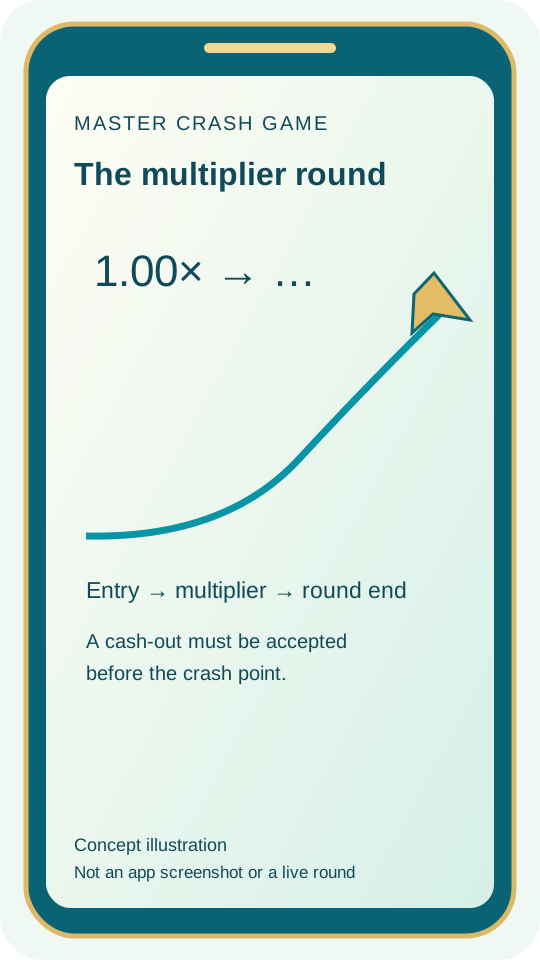
The rocket or curve shows the multiplier climbing. Cash-out asks the game to settle your entry before that round ends. Follow manual cash-out, automatic targets and round history for the details.
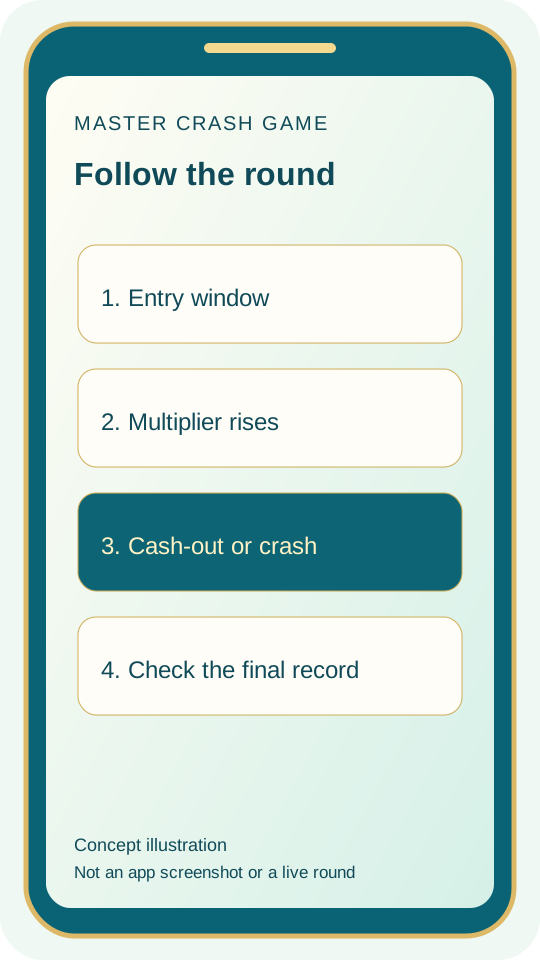
Read a Crash round, step by step
Example round · 8 unitsChoose a stage to follow the same 8-unit example from entry to result.
Before the round
Read the entry window
Choose the amount and check any automatic target while entries are open. Once that window closes, the round begins.
This example uses an 8-unit stake. It is a diagram, with no payment or account action.
During the round
Follow the multiplier
The chart is at 1.80×. Tapping cash-out sends a request; the confirmed result tells you which multiplier was used.
Auto cash-out sets a target. Auto entry places another entry. Check the game’s rules for each setting.
After the round
Check the final record
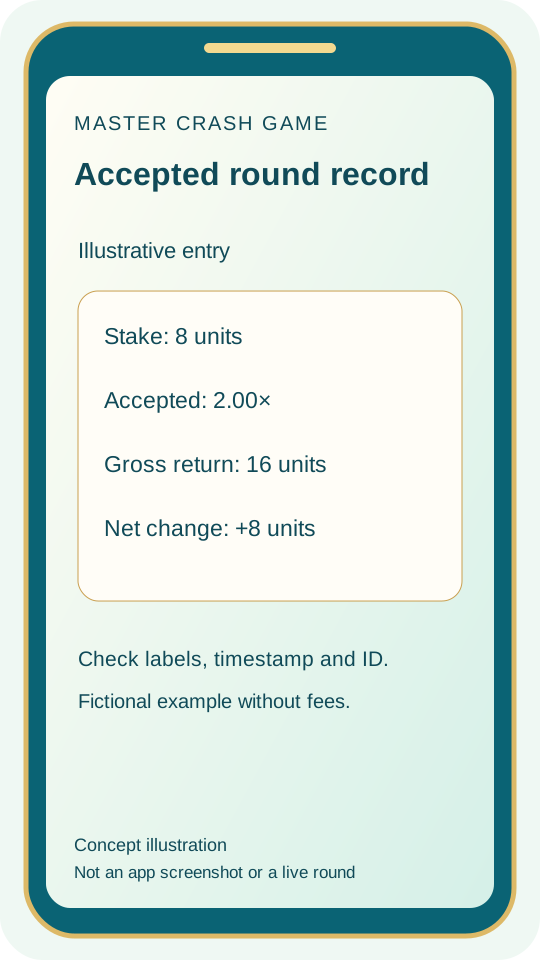
The round ends at 2.40×. Entry A cashed out at 2.00×, returning 16 units: its 8-unit stake plus an 8-unit gain.
Entry B was still running at the crash, so its stake was lost. This example does not predict the next round.
For the axes and screen labels, read the Crash chart explanation.
Concept illustrations — not screenshots of the supplied APK.
How to play Crash
- Start with the rules panel. Identify the entry window, total stake, minimum and maximum entry, and any payout cap. An amount visible in a tutorial is only an example; the current table defines what can be accepted.
- In a common Crash format the multiplier begins near 1.00× and increases during the active phase. If an entry of 10 units settles at 1.50×, its gross arithmetic result is 15 units. Fees and rounding belong to the actual product rules.
- Manual cash-out sends a settlement request before the round ends. Check the accepted confirmation and round record. A number on your screen at the instant of a tap does not prove the server accepted that number.
- A crash ends the active phase. An entry that has not been successfully settled is normally lost under this format. Do not interpret a short previous round as evidence that the next round must last longer.
- Where an automatic target is offered, review how it is saved and executed. Confirm whether it survives a closed app or a dropped connection, whether it applies to future rounds, and what happens when the round never reaches the target.

Crash variants
Classic round
One entry is associated with one round. You review the stake and decide whether to request settlement while the round remains active. An automatic target, if offered, is a separate control with its own rules. The animation communicates progress; the accepted record communicates the result. Read the cancellation deadline before assuming that a placed entry can be withdrawn.
Dual-entry mode
Some games allow two entries in the same round. Two 5-unit stakes still put 10 units at risk against the same crash point, even with different targets. Check the confirmation and result for each entry.
Provably fair verification
A product may publish a commitment and later reveal inputs for recomputing a past result. A usable verification explanation identifies the hash, seeds, round counter, calculation and applicable version. The name of a feature alone is not evidence. This website does not claim that the linked APK implements such a verifier or holds an independent RNG certificate.
Tips: decisions and limits
- Choose the amount of time and spending you can afford before opening a session. Treat the boundary as a stopping point, not a target to recover after losing. Short rounds can hide the total accumulated exposure.
- Understand gross return and net result. In the fictional 10-unit, 1.50× example, a 15-unit gross settlement includes the original 10 units; the arithmetic difference is 5 units before any product-specific adjustments.
- Do not turn recent history into a prediction. A visible sequence is a record of completed rounds. Without a documented dependence in the game model, it gives no basis for promising the next crash point.
- Check a target and an entry amount together. If you change one, re-read the other before a round. Stop and review the record if the state appears pending or the connection is unstable.
Tables, stakes and timers
Look for the minimum and maximum stake, entry deadline and payout cap on the game screen. With two entries, check the combined amount as well as each target. If the connection drops, use the round ID and result to check what happened; repeatedly tapping a frozen screen will not clarify the status.
How to evaluate fairness
Start with the game’s own documentation. A provably fair tool should give you the inputs and calculation needed to check a past round. An audit should name its issuer, version and coverage. Neither proves that you will win, and the APK checksum on our download page is a file check rather than a game-fairness test.

Common mistakes
- Treating a cash-out tap as a settled result. Save the accepted confirmation rather than only the number that appeared on the curve. A pending or rejected request needs the relevant round record.
- Assuming an automatic target prevents losses. The round may end below the target. The feature’s handling of disconnection also varies; it needs a clear product explanation before you rely on it.
- Increasing an entry after losing to make a planned recovery. With fictional stakes of 10, 20 and 40 units, three losses total 70 units. The next entry does not undo that accumulated exposure.
- Buying a predictor or sharing account access with someone who promises a result. A guide, chart or remote-access tool is not evidence of future outcomes. Keep codes, passwords and payment PINs private.
Crash glossary
- Multiplier
- The displayed factor during a round. An accepted settlement uses the value in the result record.
- Cash-out
- A request to settle an active entry under the round rules. A bank withdrawal is a separate transfer.
- Crash point
- The endpoint of the round. In the common format, an entry still active at that point loses its stake.
- Auto cash-out
- A target condition for settlement where supported. Check execution and connection rules.
- Auto entry / autoplay
- A separate setting for subsequent entries where supported. It does not imply an automatic cash-out target.
- Accepted record
- The service’s record of the entry and result. A frozen local display does not decide the accepted action.
- Seed / commitment
- Terms used by some verification systems. Read a complete published specification before interpreting a hash.
- RTP / house edge
- Long-run properties of a stated model. They do not promise the result of a personal session.
Continue with the chart guide, fairness terminology and RTP explained.
Crash FAQ
How do Crash multipliers and cash-out work?
For example, an 8-unit stake cashed out at 2.00× returns 16 units: your 8-unit stake plus an 8-unit gain, before any fees. Use the multiplier in the confirmed result. See stake, return and Crash profit for the calculation.
What is auto cash-out in a Crash game?
It sets a multiplier at which to request cash-out automatically, where the game offers this option. If the round crashes first, the target will not be reached. Check the game’s connection rules too. Our auto cash-out guide explains the difference from auto entry.
Can Crash round history predict the next result?
No. A run of low multipliers does not tell you that a high one is due. History is useful for checking a past round, its ID and your result. Learn how to read Crash round history.
What happens if a Crash game connection drops?
A frozen screen cannot show whether the game received your request. Check the round record when you reconnect. Keep the round ID, time and error message if the result needs explaining.


