


A round ends at 2.10×, but your entry shows 1.40×. Those figures can both be correct: one is the round’s endpoint and the other is your cash-out. History is useful for sorting out details like these. A run of past multipliers, however, tells you what has happened without establishing what must happen next.
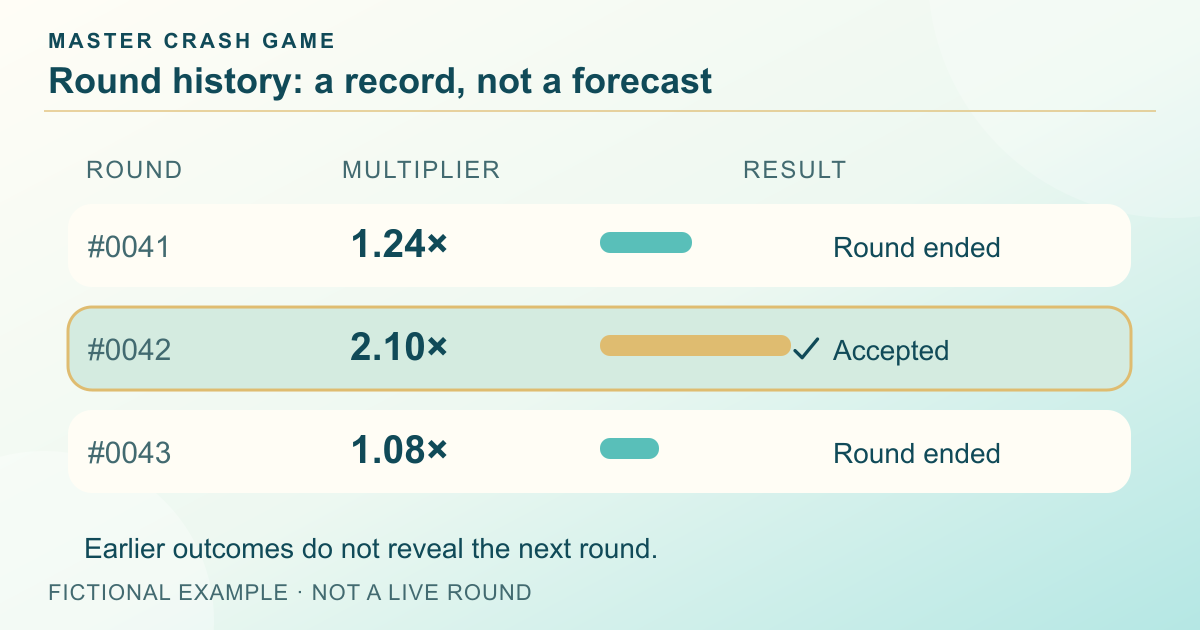
What a history panel records
Start with the round ID and check what each number refers to. A history strip may show only where rounds ended; a detailed entry record can also show your stake and cash-out. Products may display different fields or rounded values. For a disputed result, keep the detailed record rather than a cropped piece of the animation.
Past outcomes and the next round
A sequence of low or high values does not by itself prove that a particular future value is due. Looking for a visual pattern can encourage overconfidence. Without a documented dependence in the game model, do not use a recent sequence as a reason to increase an entry.
Verification has a limited purpose
A published seed and algorithm may let a user recompute a past result. The inputs must be complete and the calculation must match the relevant version. Verification of one calculation is different from proof of an independent audit, and neither guarantees a future payout.
Keeping records for a question
Capture the round identifier, date and time including timezone, displayed result and confirmation. Hide account secrets and personal information before sharing. A factual record helps explain a disagreement; a prediction or an edited screenshot does not establish settlement.
Read a complete illustrative record
For a fictional record, round R-24 ends at 2.10× while a 10-unit entry was accepted at 1.40×. The gross return is 14 units in the no-fee illustration, not 21: the final round multiplier and the accepted entry multiplier are different fields. Another entry in the same round can have a different result.
Swipe sideways to read the full table →
| Field | Example | Meaning |
|---|---|---|
| Round end | 2.10× | Where the round finished |
| Accepted cash-out | 1.40× | Where this entry settled |
| Stake | 10 units | Amount committed |
| Gross return | 14 units | Illustrated credited amount |

Keep verification reproducible
To repeat a verification calculation, keep the algorithm, complete inputs and version together. Note which input was committed before the round and which was revealed afterward. That evidence can support a check of the completed calculation. It does not establish an external audit, account eligibility or the profitability of future rounds.
Frequently asked questions
Can the final round multiplier differ from my cash-out?
Yes. An entry may settle before the round finishes.
Does a history pattern prove a result is due?
No. A pattern alone does not establish a documented dependence.
What makes a past calculation verifiable?
Complete relevant inputs, the documented algorithm and the correct version are needed to reproduce it.
Sources and scope
Examples use the rules and fictional units stated in the article. Check the actual product for its available modes, rules and conditions; no outcome or payment is promised.
Arithmetic, fictional scenarios and editorial checklists are independently written for this website. Read our editorial policy for how claims and updates are handled.
Adults 18+. Set time and spending boundaries before participation. Read the limits and breaks guide.
Keep the file details handy
If you are also checking your installation, the download page lists the selected file’s version, size and checksum for comparison.
Review Master Crash APK file detailsRelated reading
Crash Predictor Claims: Can They Be Trusted?
Assess Crash predictor claims, historical patterns and tool screenshots. Separate a recorded observation from evidence of a reliable future prediction.
Read the guide Revat Desai
Crash Profit Calculation: Stake vs Return
Calculate a Crash net result from stake, gross return and fees. Work through single-round and mixed-session examples without counting an entry twice.
Read the guide Mithila Kamat
Crash Auto Cash Out: What If You Disconnect?
Understand Crash auto cash-out targets and connection loss. Check which action the service accepted and how the final settlement is recorded.
Read the guide Yuvan Kurup