


An 18-unit return from an 8-unit entry means a 10-unit gain before fees. It is easy to count all 18 as profit when a screen uses a loose label such as “win”. Keeping the stake, gross return and net result in separate columns makes an individual round—and a mixed session—much easier to check.
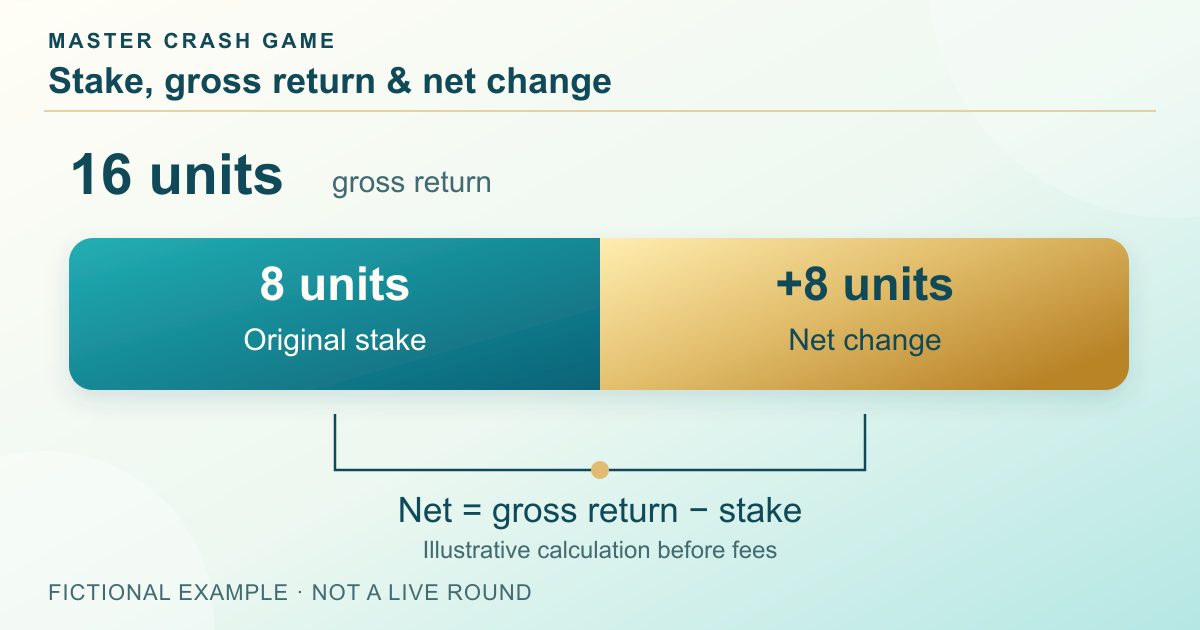
Define the three amounts
Stake is the amount committed to the entry. Gross return is what a successful result credits under the stated rules. Subtract the stake and any cost not already deducted to get the net profit. On a losing entry, the gross return can be zero while the net result is negative. Keep each label beside its number.
Follow a complete numerical example
Suppose a fictional 8-unit entry settles at 2.25×. Multiplication gives an 18-unit gross return. Subtracting the 8-unit entry gives a 10-unit gain. If a separate 1-unit fee applies, the gain becomes 9 units. This example does not assert a fee or multiplier for the installed app.
Swipe sideways to read the full table →
| Case | Gross return | Net result before fees |
|---|---|---|
| 8 units at 2.25× | 18 units | +10 units |
| 8 units at 1.10× | 8.8 units | +0.8 units |
| 8-unit losing entry | 0 units | −8 units |

Combine rounds using net results
Adding only the positive return column overstates what a session gained. Include every entry, including entries with no return. An account balance can also change because of deposits, withdrawals or fees unrelated to a round. Use a round ledger for round results and a separate account ledger for movements between accounts.
Worked example
A mixed session
Two entries of 8 units settle at 1.50×, each gaining 4. A third 8-unit entry loses. The combined gross return is 24, the combined stake is 24 and the net result is zero before fees.
Check rounding and caps
A displayed multiplier may be rounded while the settlement calculation uses a more precise value. A maximum return can also limit a large entry. Read which field is authoritative and preserve its exact amount. If two screens disagree, record their labels and timestamps rather than assuming the larger value is the settled one.
Keep a small, readable ledger
Write the round ID, stake, accepted multiplier, credited return and fee in separate columns. Calculate the net result once. This helps explain an arithmetic question to support and makes total exposure visible. It should not become a reason to keep playing until a target balance is reached; a preselected time or spending boundary still applies.
Frequently asked questions
Is gross return the same as profit?
Usually no. In the illustrated model, gross return includes the original stake and profit subtracts it.
Why can a balance change differ from round profit?
Deposits, withdrawals, fees and unsettled entries can affect the balance. Separate these movements from completed round results.
Should I round each step?
Use the product’s documented settlement precision. For a personal illustration, state the rounding method and apply it consistently.
Sources and scope
Examples use the rules and fictional units stated in the article. Check the actual product for its available modes, rules and conditions; no outcome or payment is promised.
Arithmetic, fictional scenarios and editorial checklists are independently written for this website. Read our editorial policy for how claims and updates are handled.
Adults 18+. Set time and spending boundaries before participation. Read the limits and breaks guide.
Keep the practical details together
Alongside your calculation notes, the download page gives you a place to check the Android requirement, file size and installation steps.
See Master Crash APK file informationRelated reading
Crash Cash Out Targets: The Break-Even Maths
Calculate a fictional Crash cash-out target, gross return and break-even threshold. Separate arithmetic conditions from an unknown real success probability.
Read the guide Neeladri Basu
Crash Game History: What Do Past Rounds Show?
Read Crash game history by round ID, multiplier and settlement. See why earlier outcomes do not establish the next result or validate a prediction.
Read the guideNeeladri BasuGaming Session Limits: Plan Time and Spending
Set gaming session limits before Teen Patti, Rummy or Crash play. Choose a time boundary, record spending and plan a break before the session begins.
Read the guide Revat Desai