


A maximum multiplier and a maximum win answer different questions. One describes a multiplier boundary; the other limits an amount under stated rules. A headline can show both while leaving their interaction unexplained. Before using a stake-times-multiplier calculation, find the amount limit, its scope and the product’s definition of a win. Otherwise a correct multiplication can still produce the wrong settlement expectation.
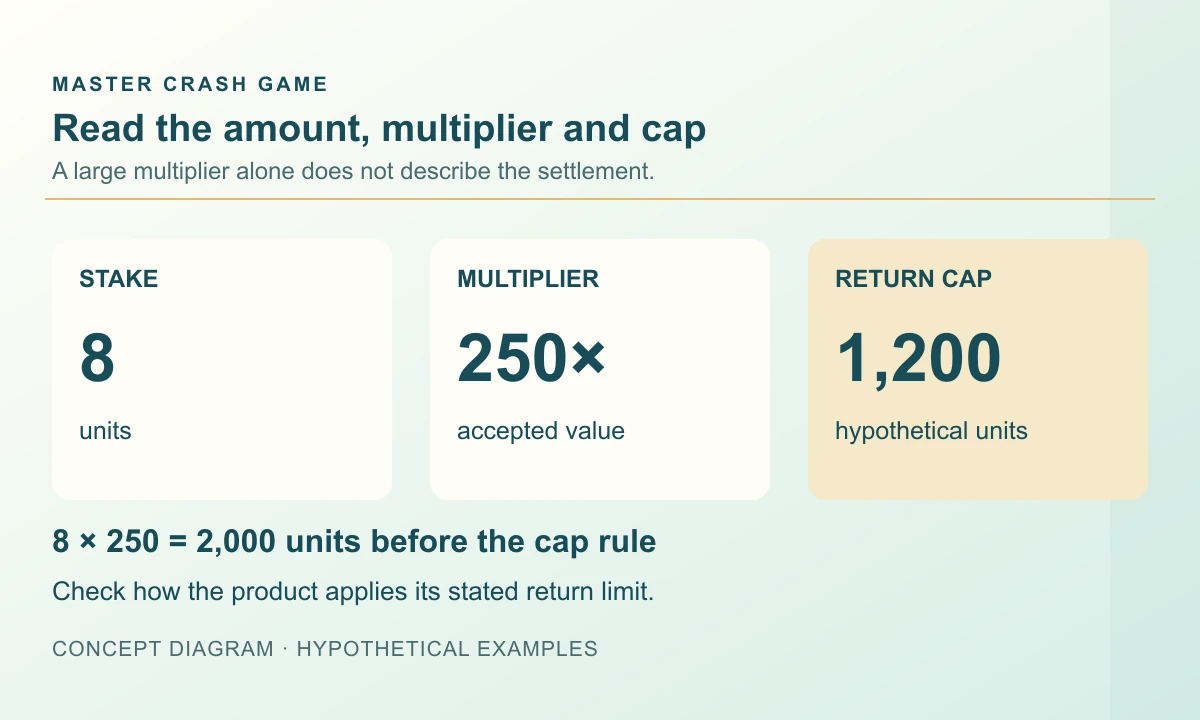
Separate four fields that often sit together
A minimum or maximum stake defines which entry amounts are permitted. A maximum multiplier defines a ratio boundary. A maximum payout or win defines an amount boundary, although the wording must be checked to see whether it means gross return or net winnings. An auto-cashout limit describes the targets accepted by that particular control.
These fields need not have the same numerical relationship in every product. A target input stopping at one value does not establish the entire game’s maximum multiplier. Likewise, a high maximum multiplier does not mean every allowed stake can receive an unlimited currency amount. Read the labels and their definitions together.
Use a supplier specification as a reading example
BGaming’s Space XY product page lists a maximum multiplier of 10,000× and a Max Win amount of €250,000 as separate specifications. The useful observation is that the supplier publishes both a ratio and an amount. Those figures belong to that named product page; they are not limits established for Master Crash Game’s Android download.
Those fields alone do not explain every operator’s currency treatment, rounding or settlement scope. Consult the applicable help and terms. Do not convert a euro specification into another currency without an explicit rule.
Calculate the uncapped return before applying a cap
Consider a wholly fictional rule set with a 40-unit stake, a 1,000× accepted multiplier and a 25,000-unit cap on gross return per entry. Before the cap, 40 multiplied by 1,000 is 40,000 units. Applying that particular cap gives a gross return of 25,000. The net result is 24,960 after subtracting the original 40-unit stake, before any separate cost.
The example assumes the cap limits gross return and that the accepted multiplier is otherwise payable. If the rules instead cap net winnings, the calculation changes. A maximum also does not promise that the round will reach it. Keep the hypothetical rule and the observed result separate when showing an example to another reader.
Swipe sideways to read the full table →
| Hypothetical field | Value | Calculation meaning |
|---|---|---|
| Original stake | 40 units | Amount committed once |
| Accepted multiplier | 1,000× | Uncapped gross return: 40,000 units |
| Gross-return cap per entry | 25,000 units | Return limited to 25,000 units |
| Final net result before costs | +24,960 units | 25,000 minus the 40-unit stake |

Check whether the cap covers an entry or a group
The words “per bet,” “per round,” “per account” and “per day” define different scopes. With two accepted entries, a per-entry limit may be applied separately, while an aggregate round limit concerns their combined result. You cannot choose between those interpretations by looking at the number of entry panels.
Record the scope beside the amount, including any stated currency and time period. If a combined cap exists, find the rule explaining how it is applied across entries. Do not divide an aggregate amount between panels by guesswork. An unexplained field is a question for the product’s support route, not a missing number to fill in yourself.
Find the rule for reaching a boundary
A specification showing a maximum does not necessarily explain how the game handles that boundary. The help should say whether an outstanding entry is automatically settled, whether the round ends or whether another condition applies. Read that procedure separately from the visual animation and from your chosen auto-cashout target.
Rounding can also affect the credited amount. Check the precision used for stakes, multipliers and final currency values. Preserve the actual accepted entry record when comparing an expected amount with a credited one. A cropped screenshot of a large multiplier omits most of the fields needed to explain the difference.
Keep game limits separate from payment limits
A cap on game settlement and a limit in an account’s withdrawal process govern different stages. Winning or returning an amount in a game does not, by itself, define an available payment method or processing schedule. Read the account’s balance labels and payment terms separately rather than treating the game’s maximum-win field as a withdrawal promise.
Record the game, version, currency, maximum stake, multiplier boundary, amount cap and scope. Add the applicable help link and unresolved conditions. This checks a calculation; it gives no reason to increase a stake or pursue a high multiplier. Neither the example nor a supplier specification guarantees a result.
Frequently asked questions
Does a 10,000× maximum mean every stake can return 10,000 times its value?
An amount cap or another rule may limit the payable return. Read the product’s current limits and their scope together.
Is a maximum win the same as a maximum withdrawal?
No. Game settlement and an account’s payment process are different stages with separately defined terms.
Can I use Space XY’s published limits for the Master Crash Game APK?
No. Those specifications describe BGaming’s named product. The linked app’s own game limits require product-specific documentation.
Sources and scope
Examples use the rules and fictional units stated in the article. Check the actual product for its available modes, rules and conditions; no outcome or payment is promised.
Adults 18+. Set time and spending boundaries before participation. Read the limits and breaks guide.
File information for Android
When you are ready to review the Android download, Master Crash lists the selected APK’s file information and installation guidance.
Open Master Crash APK detailsRelated reading
Crash Profit Calculation: Stake vs Return
Calculate a Crash net result from stake, gross return and fees. Work through single-round and mixed-session examples without counting an entry twice.
Read the guide Mithila Kamat
Crash Cash Out Targets: The Break-Even Maths
Calculate a fictional Crash cash-out target, gross return and break-even threshold. Separate arithmetic conditions from an unknown real success probability.
Read the guide Neeladri Basu
Compare Crash game features: controls, modes and records
Compare Aviator, JetX, Space XY, Spaceman and CarX by documented controls and mode differences, without copying their product claims.
Read the guideNeeladri Basu