


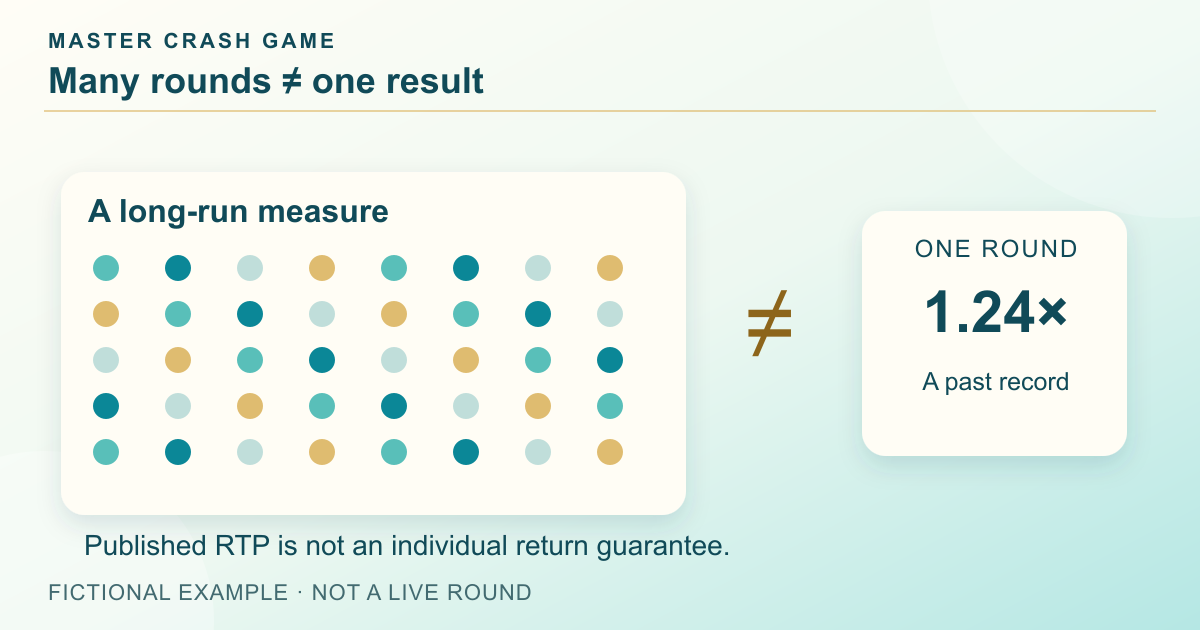
An RTP figure describes a long-run model, not the amount a player gets back from a deposit or a short session. To read it properly, you need to know what was counted, which rules apply and whether the number is theoretical or measured. No product-specific RTP has been verified for the Android package linked from this site.
Treat RTP as a model description with a scope
The UK Gambling Commission’s player guidance explains that RTP is an average across a significant volume of play, rather than the return each time a game is played. Its examples concern gaming machines; the distinction between a long-run average and a session promise is the useful concept here. They do not certify a Crash product or set its rate.
A Crash supplier’s published percentage still needs a product name, rule version and applicable conditions. BGaming’s Space XY page lists 97% for that title. That figure belongs to the named supplier game, not every rocket-themed game and not this site’s download. A similar-looking curve is no evidence that two products share a distribution.
Distinguish turnover from the money first deposited
Turnover is the sum committed across the entries being counted. A starting amount can be committed again after a return, so turnover can exceed the initial deposit without another deposit occurring. Gross returns should be counted on the same basis and include the entry portion wherever the rules define it that way.
For a fictional accounting example, three entries of 10 units create 30 units of turnover. If their gross returns are 15, 0 and 12 units, the combined gross return is 27 and the net result is minus 3 units before any separate cost. The observed ratio is 27 divided by 30, or 90%. These invented results describe only that example, not a measured product rate.
Swipe sideways to read the full table →
| Quantity | Fictional example | Meaning |
|---|---|---|
| Turnover | 30 units | Total committed across three entries |
| Gross return | 27 units | Total returned, including returned stakes |
| Net result | −3 units | Gross return minus turnover, before costs |
| Observed return ratio | 90% | Ratio for this tiny invented sample |
Understand the house-edge complement carefully
When a stated model defines RTP and house edge over the same wagers and includes the same rules, the edge can be expressed as 100% minus RTP. In a wholly fictional 96% model, that complement is 4%. Multiplying 1,000 units of turnover by 4% gives an expected 40-unit difference under those assumptions. It is not a fixed fee or a predicted loss of exactly 40.
That shortcut is incomplete if the quoted quantities use different bases or exclude costs and special conditions. Read fees, rounding, payout caps and eligibility rules separately. The return associated with a specific target also requires the documented outcome probabilities and acceptance rules; a larger displayed multiplier alone does not establish a better expected result.
Do not use a short session to repair a long-run average
An observed ratio is calculated from results already counted. A theoretical ratio comes from a specified model. The UK Gambling Commission’s monitoring guidance treats actual RTP, volume and volatility together when assessing deviations. A small personal sample supplies much less evidence than the same ratio might suggest when printed as a precise percentage.
A session above or below a published average does not create an obligation for the next round to compensate. Continuing to increase turnover exposes additional amounts; it does not turn a long-run percentage into a refund schedule. Include losing entries and avoid selecting only the successful part of a record when evaluating what happened.
Compare documentation before comparing percentages
Put the supplier, game, version and applicable mode beside the quoted RTP. Check whether fees, caps or feature conditions sit outside that figure. Comparing bare percentages loses those details. For the linked Android app, product documentation and confirmed modes are still needed before a rate can be stated; Space XY’s published rate belongs to Space XY.
Keep financial boundaries independent of an RTP claim. A theoretical average cannot tell you what an affordable loss is or promise that a planned session will finish at a particular balance. For this site’s linked app, the correct next step is obtaining product documentation and confirming its actual game modes, rather than importing a rate from Space XY or another reference game.
Frequently asked questions
Does 97% RTP mean I get 97% of my deposit back?
No. A quoted RTP is a long-run model average over the relevant wagers, not a guaranteed deposit or session return.
Is a three-round observed return the game’s true RTP?
No. It describes that small sample. It cannot establish the model or reliably measure long-run performance.
What RTP does the Master Crash Game download have?
A product-specific rate has not been verified. Another supplier’s published percentage should not be assigned to it.
Sources and scope
Examples use the rules and fictional units stated in the article. Check the actual product for its available modes, rules and conditions; no outcome or payment is promised.
Adults 18+. Set time and spending boundaries before participation. Read the limits and breaks guide.
Review the Android file
For the Android side of your research, use the recorded version, requirements and checksum to compare the file you plan to install.
Review Master Crash Android file detailsRelated reading
Crash Cash Out Targets: The Break-Even Maths
Calculate a fictional Crash cash-out target, gross return and break-even threshold. Separate arithmetic conditions from an unknown real success probability.
Read the guide Neeladri Basu
Crash Profit Calculation: Stake vs Return
Calculate a Crash net result from stake, gross return and fees. Work through single-round and mixed-session examples without counting an entry twice.
Read the guide Mithila Kamat
Crash fairness explained: RNG, commitments and verification limits
Distinguish RNG claims from a reproducible round check, and learn which product-specific inputs and rules verification needs.
Read the guideNeeladri Basu