

A game can mention both RNG and “provably fair”, yet the two claims need different checks. RNG concerns how random outcomes are generated. A verification scheme lets someone repeat a documented calculation using the required data. Neither label tells you, by itself, what the linked Android app implements. Begin with the named product, its rules and a completed round.
Name the claim you are trying to check
RNG means random number generator. A supplier may describe testing or certification of that generator. BGaming, for example, describes Space XY as governed by certified RNG protocols. SPRIBE presents provably fair technology separately in its supplier overview. These are provider statements about their own offerings; they are not certificates or capabilities that this site can borrow.
Write the question precisely: was a completed result calculated from the documented inputs, does a test report apply to this build, or was a request handled according to its rules? These questions need different evidence. A logo saying “fair” is not a replacement for an algorithm description, a report identifier or an accepted round record.
Understand what a commitment can establish
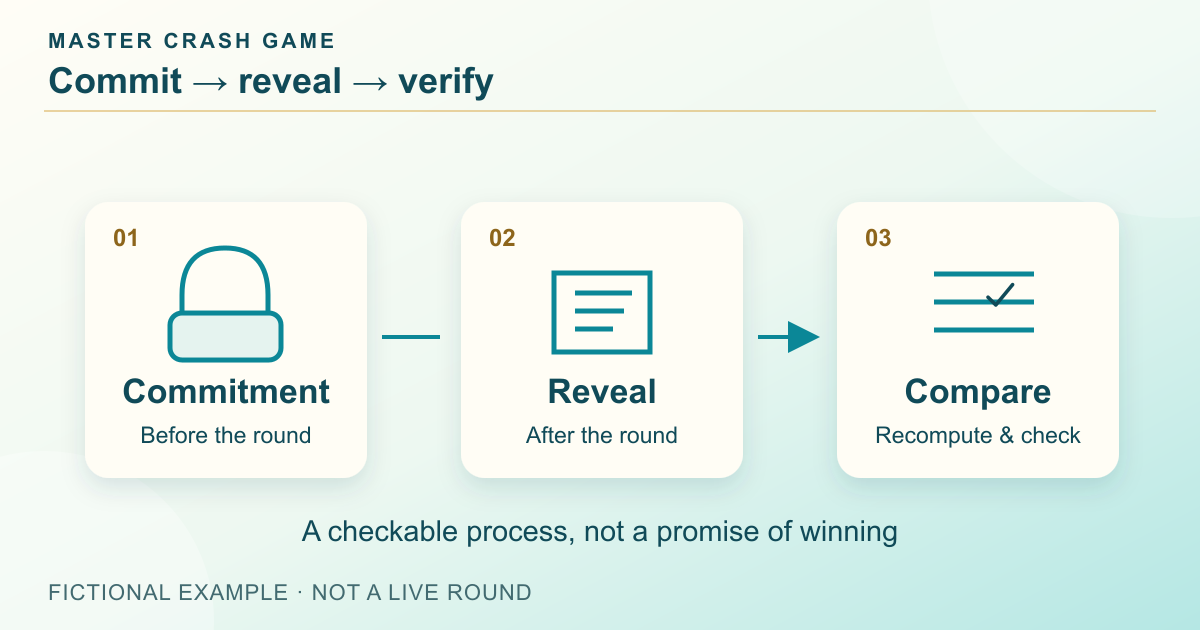
A commitment-and-reveal design can publish a hash associated with an input before play and disclose the input later. In a correctly specified scheme, comparing the later input with the earlier commitment helps check that it was not substituted after the commitment. The exact hash method, encoding, disclosure schedule and inputs belong to the individual implementation.
Stake’s implementation page documents its own use of server and client seeds, a nonce and a cursor to generate bytes. Its game-events page separately explains that bytes must be converted into game-specific outcomes. Those descriptions illustrate why inputs and conversion both matter. They should not be substituted for an Aviator, JetX or other Crash game’s own rules.
Collect enough information to repeat a completed check
Start with the original commitment, the revealed input, the round or entry identifier and the published calculation for the applicable version. Preserve exact strings: a copied space, changed character case or incorrect identifier can make a calculation differ. A usable verifier should explain which field goes where and which final value it recomputes.
Then compare the calculated outcome with the recorded outcome under the product’s rounding and conversion rules. A matching hash alone checks a commitment relationship; it does not automatically check the multiplier conversion. Conversely, a mismatching calculation can begin with a wrong input or wrong version. Document the disagreement before deciding what caused it.
Swipe sideways to read the full table →
| Evidence | Question it helps answer |
|---|---|
| Original commitment and revealed input | Does the later input match the earlier commitment? |
| Documented algorithm and version | Can the stated process be reproduced? |
| Round or entry record | Which recorded outcome should be compared? |
| Conversion and rounding rules | How does the generated value become the displayed result? |
Keep calculation checks within their scope
Repeating the documented calculation tells you something about that result. To check when a cash-out request arrived, you need its timing record and handling rules. A withdrawal needs account and payment records. Operator identity and the authenticity of an app need separate evidence too; a matching calculation cannot settle all of these questions.
Verification also differs from prediction. Inputs disclosed only after a completed round do not become advance knowledge about another undisclosed round. A service selling “fairness access” as a guaranteed next multiplier has changed the claim. Ask what was actually available before the round and which published process connects it to that future value.
Record an honest result when evidence is missing
Write the result as precisely as you can: “this disclosed input matches the earlier commitment” or “the supplied data did not reproduce this version’s result.” Keep the documentation link and review date. A passing hash check can leave the multiplier conversion unchecked, while a mismatch may still need the inputs or version corrected.
Master Crash Game provides this reading guide, not a functioning verifier or an assertion that the linked Android package implements a particular fairness system. Before claiming such a feature for the app, obtain its actual provider, version, verification instructions and a completed test record. An unanswered question should remain unanswered rather than being filled with another provider’s credentials.
Frequently asked questions
Does provably fair mean I can predict the next Crash round?
No. A completed-result check does not reveal undisclosed future inputs or establish a prediction system.
Do all Crash games use the same seeds and hash algorithm?
No. Each implementation specifies its own inputs, commitments, conversions and verification procedure.
Has this site verified the Android app’s fairness system?
No product-specific verification has been established. This guide explains the evidence needed before making that claim.
Sources and scope
Examples use the rules and fictional units stated in the article. Check the actual product for its available modes, rules and conditions; no outcome or payment is promised.
Adults 18+. Set time and spending boundaries before participation. Read the limits and breaks guide.
Follow up with a file check
For a download check alongside your fairness research, compare the selected APK’s recorded details and checksum on the Master Crash download page.
View Master Crash APK download checksRelated reading
Crash Predictor Claims: Can They Be Trusted?
Assess Crash predictor claims, historical patterns and tool screenshots. Separate a recorded observation from evidence of a reliable future prediction.
Read the guide Revat Desai
Crash Game History: What Do Past Rounds Show?
Read Crash game history by round ID, multiplier and settlement. See why earlier outcomes do not establish the next result or validate a prediction.
Read the guide Neeladri Basu
Crash RTP and house edge: understand the long-run numbers
Separate theoretical RTP, measured returns, turnover and short-session results without assuming a rate for an unverified app.
Read the guideRevat Desai