

There is no single number of seconds that applies to every Crash round. A countdown measures time until a start or entry cutoff. The live phase ends when the round crashes, and the time before the next round can include a results display. Decide which interval you mean before comparing two timings.

There are three clocks people call “round length”
Swipe sideways to read the full table →
| Interval | Start and end |
|---|---|
| Entry window | The entry panel opens, then closes for that round. |
| Live round | The multiplier starts moving, then the result is recorded. |
| Start to start | One round begins, then the next one begins. This can include a post-round pause and countdown. |
The countdown is visible in some interfaces, but it is not a timer for how long the multiplier will rise. For the rules of a particular game, check the labels and entry cutoffs documented by its publisher.
Measure one clip without mixing intervals
In a fictional recording, the countdown starts at 00:04, the multiplier begins at 00:09, the round ends at 00:14, and the following round starts at 00:22. In that clip, the entry countdown and live phase each occupy five seconds. The start-to-start interval is thirteen seconds. All three answers describe the same recording.
If you only have a screenshot of the final result, it gives no start time. If you only have a video, buffering, editing, frame rate or a reconnect can affect the visible timing. Write down which markers you used rather than quoting the result as a product-wide average.
Why the last multiplier is not a stopwatch
A result such as 2.00× is a multiplier, not a duration. To infer duration from a multiplier you would need the growth curve for the specific product and clear evidence that the clock ran continuously. Similar-looking games can animate at different rates. Even a good estimate of how long a previous round lasted does not tell you how long the next one will run.
The Crash chart guide explains what the multiplier trace represents. Use the average multiplier guide if you are summarising results rather than measuring time.
Know which question your timing can answer
For a delayed screen, compare the visible phase with the settled record and note your device’s reconnect time. For an entry that appeared too late, check which round accepted it. For a question about the advertised countdown, compare the same mode across several complete recordings and keep any interrupted clips separate. A timing difference alone does not show why an entry failed or whether a cash-out request was received.
For that distinction, see what a disabled Cash Out control can mean.
Frequently asked questions
Do all Crash games use the same countdown?
No universal countdown applies. Check the currently selected game and mode.
Can I use the previous round’s time to predict the next?
A past duration records one outcome. It does not establish the next round’s endpoint.
Sources and scope
Examples use the rules and fictional units stated in the article. Check the actual product for its available modes, rules and conditions; no outcome or payment is promised.
Adults 18+. Set time and spending boundaries before participation. Read the limits and breaks guide.
Related reading
Crash Chart Explained: Axes, Round States and Results
Learn what a Crash game graph shows, how round states change and why a visible multiplier is not a settlement record.
Read the guide Yuvan Kurup
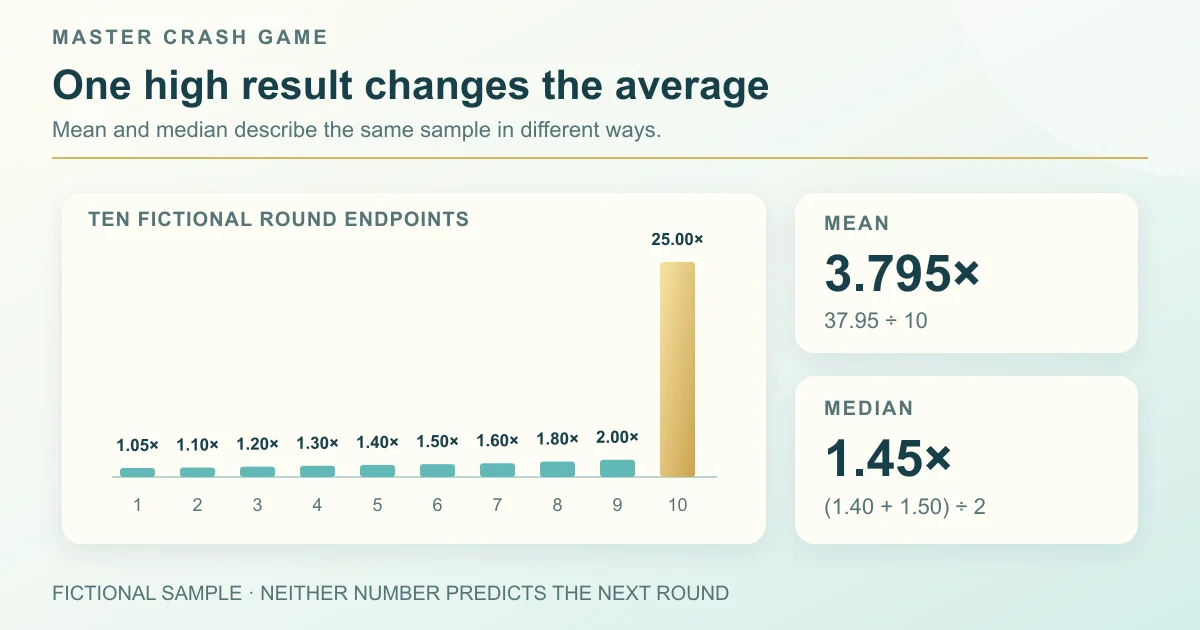
Average Crash Multiplier: Why Mean and Median Differ
Calculate an average Crash multiplier from a worked dataset. Compare mean and median, test one large value and avoid mistaking endpoints for returns.
Read the guide Neeladri Basu
Crash Cash Out: From Entry to Settlement
Follow a Crash cash-out request through entry, the live multiplier and settlement. Compare the displayed action with the accepted final record.
Read the guide Ishani Bendre