


A Crash winners list can show a successful entry without telling you how often entries succeed. The missing information is usually outside the highlighted row: which results were eligible, how many were left out and what the player staked elsewhere. Before treating a large number as evidence, find the panel’s selection rule and the meaning of its amount.
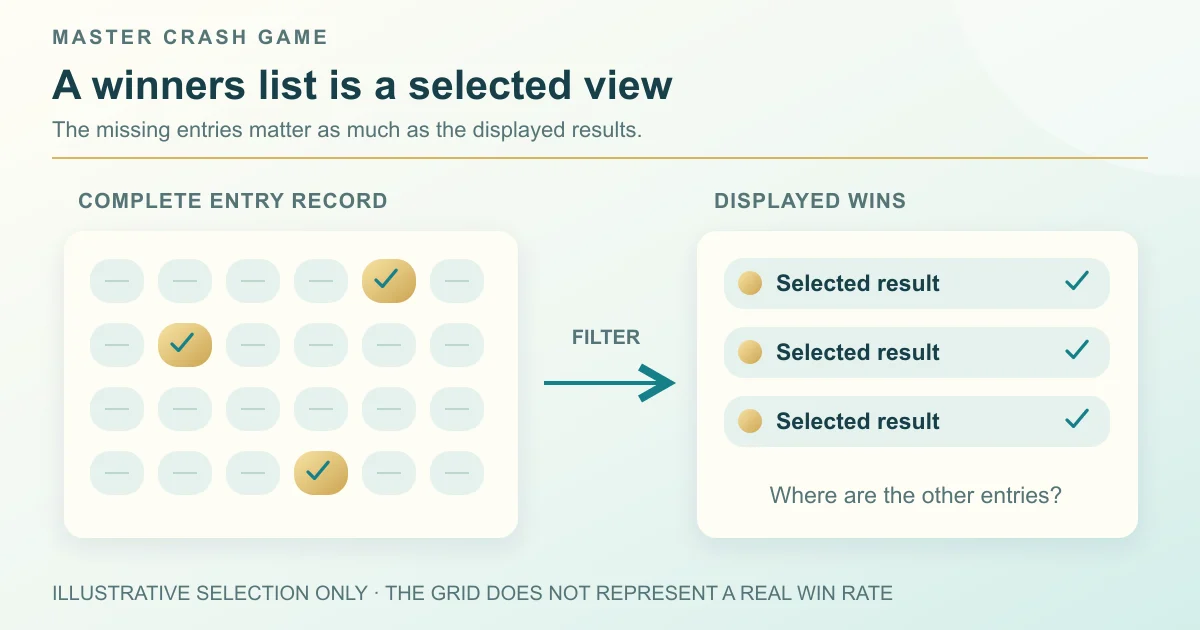
Which list are you looking at?
A live feed, a personal history and a biggest-wins board answer different questions. SPRIBE’s Aviator description distinguishes live bets from leaderboards covering daily, monthly or all-time highlights. That is a documented example from Aviator; it does not establish which panels exist in Master Crash or the linked APK.
Read the active tab before the first row. Then look for the date range, timezone, sorting field and currency or credit unit. A monthly board sorted by the largest amount is not comparable with a live feed sorted by arrival time. A label such as “Top” is incomplete until the product explains what is being ranked.
Swipe sideways to read the full table →
| Visible field | Question to resolve |
|---|---|
| Time window | Today in which timezone, a rolling period, or the entire available history? |
| Amount | Original stake, gross return, net gain, or a promotional balance? |
| Multiplier | Accepted cash-out multiplier or the round’s final endpoint? |
| Coverage | All eligible entries, this account, or a selected number of highlights? |
Keep an absent label unresolved. The Crash screen-reading guide explains why a round endpoint and an accepted cash-out can appear together without being the same result.
Three winners can sit above very different records
Imagine a fictional panel displaying exactly three entries with accepted returns. The entries are genuine within this example, and their displayed amounts are identical in both cases below. What changes is the unseen population from which those three entries were selected.
Swipe sideways to read the full table →
| Fictional completed record | Entries with returns | Entries with no return | Share with a return |
|---|---|---|---|
| Record A: 10 accepted entries | 3 | 7 | 3 ÷ 10 = 30% |
| Record B: 100 accepted entries | 3 | 97 | 3 ÷ 100 = 3% |
A screenshot containing only the three successful rows cannot tell these records apart. Dividing three displayed winners by three displayed rows produces 100%, but that describes the selected display, not all accepted entries. Neither 30% nor 3% is an estimate for any actual game: the two populations were invented to expose the missing denominator.
The counting unit matters too. Entries are not necessarily unique people, and a person may place several entries in one round. Pending, rejected or refunded entries need an explicit treatment before a rate is calculated. A useful denominator covers the same product, period, eligibility rule and counting unit as the numerator; a room’s current visitor count does not supply it.
An “average” quoted beside the highlights needs the same selection check. See how keeping only the largest multipliers changes the average, even when every displayed value is accurate.
The 200-unit highlight and the 30-unit session loss
Now follow one fictional account. One 5-unit entry settles at 40.00×, producing a 200-unit gross return under a simple stake-times-multiplier rule. The gain on that entry is 195 units. The same account also has nine completed 25-unit entries with no return. Assume no fees, bonuses, refunds or other adjustments.
Swipe sideways to read the full table →
| Fictional account record | Total staked | Gross return | Net result |
|---|---|---|---|
| One highlighted entry | 5 units | 200 units | +195 units |
| Nine other entries | 225 units | 0 units | −225 units |
| All ten entries | 230 units | 200 units | −30 units |
The highlight remains accurate in this scenario. The mistake would be converting “returned 200” into “earned 200,” or using one entry to describe the whole session. A different hidden history could produce a different session result. Without that history, neither profit nor loss has been established for a real account.
For the accounting, see stake, gross return and net result. An aggregate payout percentage also needs stakes as well as returns: the UK Gambling Commission’s calculation guidance uses those two totals. A winners-only image supplies neither a complete ledger nor a measured game-wide RTP.
What the screenshot actually establishes
Suppose a row shows “8.00×” beside a large amount. It may record a cash-out, a round endpoint or another defined field. Find the column heading or open the row’s details. If the entry settled at 2.00× and the round later ended at 8.00×, multiplying its stake by eight would misread the record. Preserve the labels when saving evidence; a tightly cropped number is difficult to interpret later.
Also preserve the selected tab, timestamp and unit. A recent capture of an all-time board can contain an old event. Two successive captures may show the same entry again, so count entry references rather than appearances. If values use different currencies, comparing the raw amounts does not establish which is larger in a common unit. Do not invent a conversion rate that the display never supplied.
A nickname or avatar is a display identifier, not independently verified evidence of the person behind it. Equally, a pseudonym is not proof that the result is fabricated. Where authenticity matters, ask for the product’s record-verification method and the relevant entry reference. An attractive image, repeated social post or confident caption cannot replace those checks.
A useful question to ask about a highlighted result
Ask a narrow question that the service can answer: “For this entry reference and timestamp, does the displayed amount include the original stake, and which period and selection rule does this panel use?” If your own result is absent, add the selected filter and its eligibility rule. You do not need another customer’s private account history to clarify how a public panel works.
When the product does not disclose enough information, the defensible conclusion is “this is a displayed highlight with incomplete context.” That leaves room for a legitimate result without turning it into a win rate, proof of session profit or a forecast for the next round.
For a more complete personal record, use the round-history checklist. If you are also checking which Android file belongs to this website’s download link, the Master Crash download information records its identity; a leaderboard image does not identify an installation package.
Sources and scope
The screen-reading questions apply to the panel and rules actually being viewed. Aviator is a named supplier example, not an inspected feature of the APK linked here. All account records and populations in this article are invented.
Written from the cited supplier description and the original ledger examples. No live winners feed, customer identity, account balance or installed-app functionality was independently verified.
Adults 18+. Set time and spending boundaries before participation. Read the limits and breaks guide.
Related reading
Crash Game History: What Do Past Rounds Show?
Read Crash game history by round ID, multiplier and settlement. See why earlier outcomes do not establish the next result or validate a prediction.
Read the guide Neeladri Basu
Crash Profit Calculation: Stake vs Return
Calculate a Crash net result from stake, gross return and fees. Work through single-round and mixed-session examples without counting an entry twice.
Read the guide Mithila Kamat
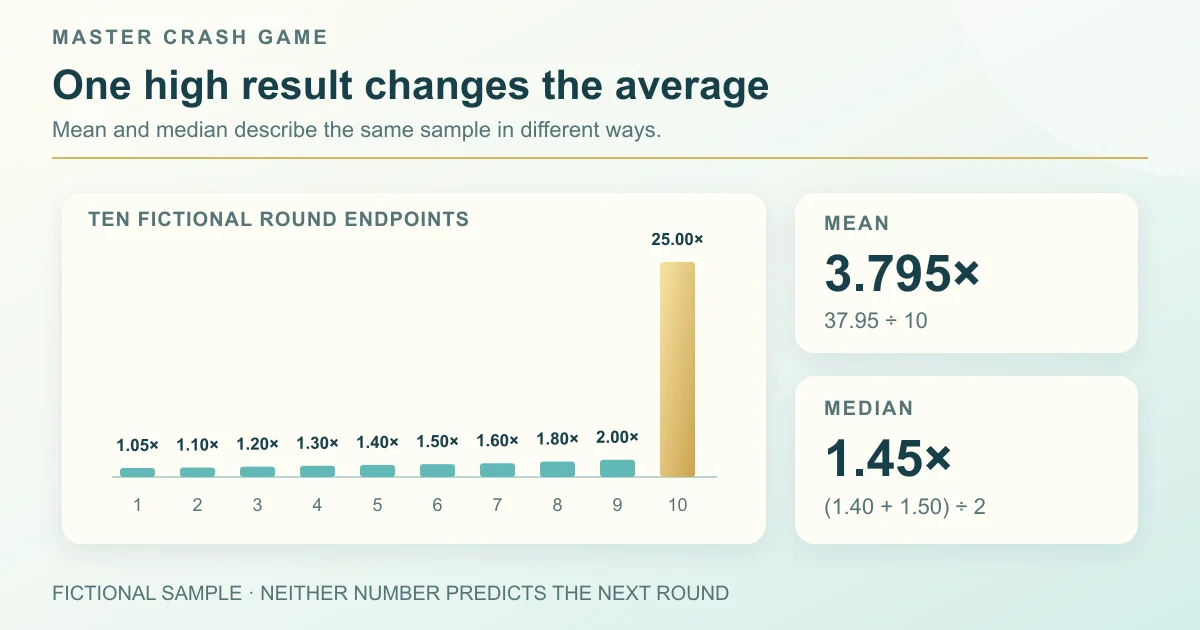
Average Crash Multiplier: Why Mean and Median Differ
Calculate an average Crash multiplier from a worked dataset. Compare mean and median, test one large value and avoid mistaking endpoints for returns.
Read the guideNeeladri Basu