


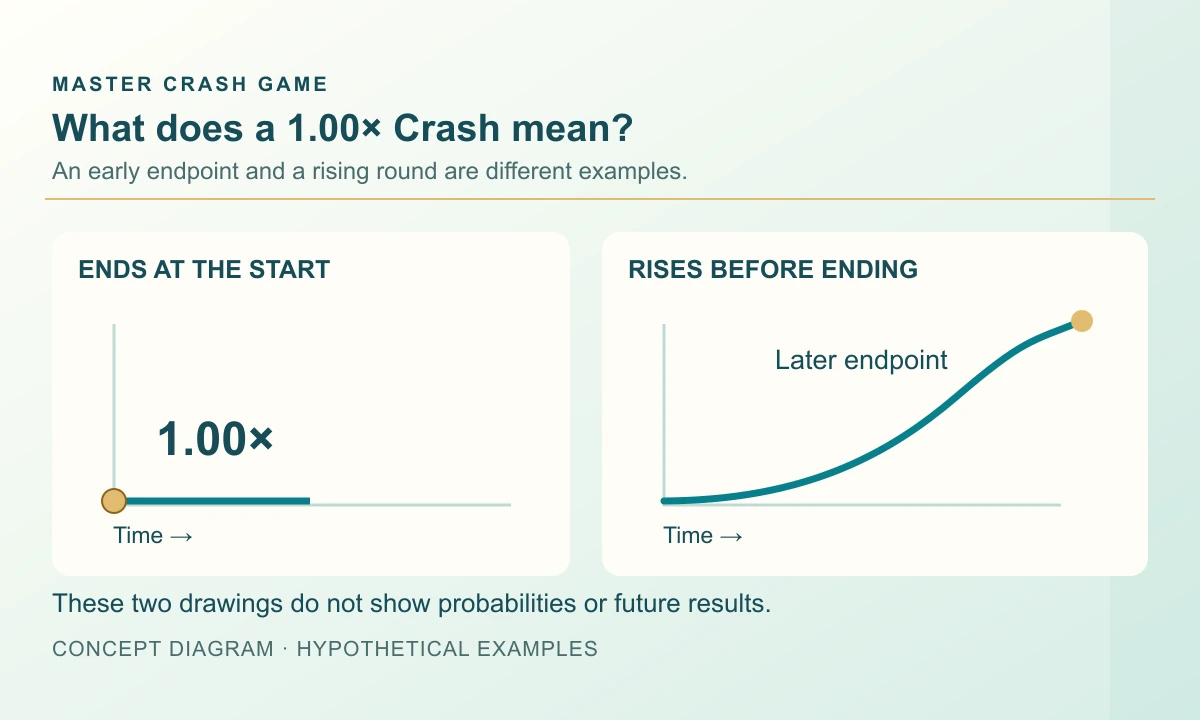
The multiplier appears at 1.00x and the round ends almost at once. It can look as though nothing happened, especially when the animation barely moves. But 1.00x on a screen can be a starting value, an ending value or part of a settled record. Those meanings are not interchangeable. This guide explains the distinction using a named supplier example, rather than assigning that supplier’s rules to every Crash game.
Ask which field contains 1.00x
A starting display tells you where the visible counter begins. A completed-round display tells you where that round ended. An individual entry record tells you what happened to a particular amount. Read the label around the number before doing any multiplication. A history tile and a cash-out receipt can show a similar value while answering different questions.
Pragmatic Play’s operator-hosted Spaceman Game Help v1.7 explicitly says that an ending at 1.00x loses the bets in that round. That is a documented example of an immediate ending being a result, rather than a refund. The specific help version matters: it is not evidence of the installed Master Crash Game app’s outcome model or settlement policy.
Multiplying by one requires a qualifying settlement
The calculation 8 × 1 = 8 is correct arithmetic. It says nothing about whether the rules permit a cash-out at that value or whether an exit was accepted. A return formula needs both an eligible amount and a recorded successful settlement. Without those conditions, multiplying the stake by the last number visible on the screen creates a return that the record may never have awarded.
Consider two fictional records for the same 8-unit stake. Record A says lost, with gross return zero. Record B explicitly says refunded, with 8 units credited back. Starting from 50 units and assuming no other activity, A leaves 42 while B leaves 50. These are alternative accounting examples, not two interpretations you can choose for the same entry.
Swipe sideways to read the full table →
| Fictional record | Amount committed | Amount returned | Net change |
|---|---|---|---|
| Lost entry | 8 units | 0 units | −8 units |
| Full stake refund | 8 units | 8 units | 0 units |
Separate an early result from a broken display
A round that ends quickly and a screen that stops updating may look similar in a cropped screenshot. They need different follow-up questions. Can you find a completed round identifier? Does its result agree with the entry record? Is there an error message or a cancellation notice? Preserve the full screen and the relevant history rather than treating every short flight as a technical failure.
A freeze is not proof of a refund, and a low endpoint alone is not proof of a freeze. If the display and record disagree, report the disagreement with timestamps. Avoid claiming a precise reaction window from the length of an animation. The product’s request-processing and interruption rules, rather than the apparent movement of the artwork, determine how an entry is handled.
Do not infer the next round from an instant ending
One completed result does not supply the probability of the next one. Several immediate endings still do not establish a compensation rule. Before making any numerical claim about frequency, you would need the exact documented model or a carefully defined dataset, including its source, version, sample size and counting method. A short strip of selected results is insufficient.
Be especially careful with percentages labelled “instant crash rate.” Does the count include exactly 1.00x, values displayed as 1.00x after rounding, cancelled rounds, or only a chosen date range? Those are different measurements. This article gives no universal frequency because the starting value alone does not define an outcome distribution, and another provider’s percentage cannot fill that gap.
Check the help without chasing the missed round
Find the minimum permitted auto cash-out target, the rule for an endpoint equal to that target, the treatment of an unaccepted manual request and the meaning of cancellation. Do not assume that a target of 1.00x exists simply because the counter begins there. A configured target is still conditional on the outcome and the product’s acceptance rules.
If the entry is recorded as lost and there is no unresolved discrepancy, increasing the next stake does not change that earlier result. Keep the review focused on understanding the record. If evidence is missing, note what is unknown and ask the account operator for the specific entry details. The useful goal is a clear explanation of one completed event, not a promise that a later event will recover its cost.
Frequently asked questions
Does a Crash ending at 1.00x automatically return my stake?
No. Read the specific settlement rule and entry record. A displayed endpoint is not itself a refund instruction.
Can I calculate a universal instant-crash frequency from the starting value?
No. The starting display does not define the distribution. A frequency claim needs a specified model or a properly described dataset.
Does an immediate ending guarantee a higher next round?
No such guarantee follows from that completed result. A previous loss does not establish a future compensating payout.
Sources and scope
Examples use the rules and fictional units stated in the article. Check the actual product for its available modes, rules and conditions; no outcome or payment is promised.
Adults 18+. Set time and spending boundaries before participation. Read the limits and breaks guide.
Your next Android step
After reviewing the round record, find the listed APK’s Android requirements and installation guidance on the Master Crash download page.
Android file & install guideRelated reading
Crash Cash Out: From Entry to Settlement
Follow a Crash cash-out request through entry, the live multiplier and settlement. Compare the displayed action with the accepted final record.
Read the guide Ishani Bendre
Crash Game History: What Do Past Rounds Show?
Read Crash game history by round ID, multiplier and settlement. See why earlier outcomes do not establish the next result or validate a prediction.
Read the guide Neeladri Basu
Crash bet pending, accepted or cancelled: what each status tells you
Read Crash bet statuses before retrying. Separate submitted requests, accepted entries, rejected bets, cancellations and recorded refunds.
Read the guide Mithila Kamat